
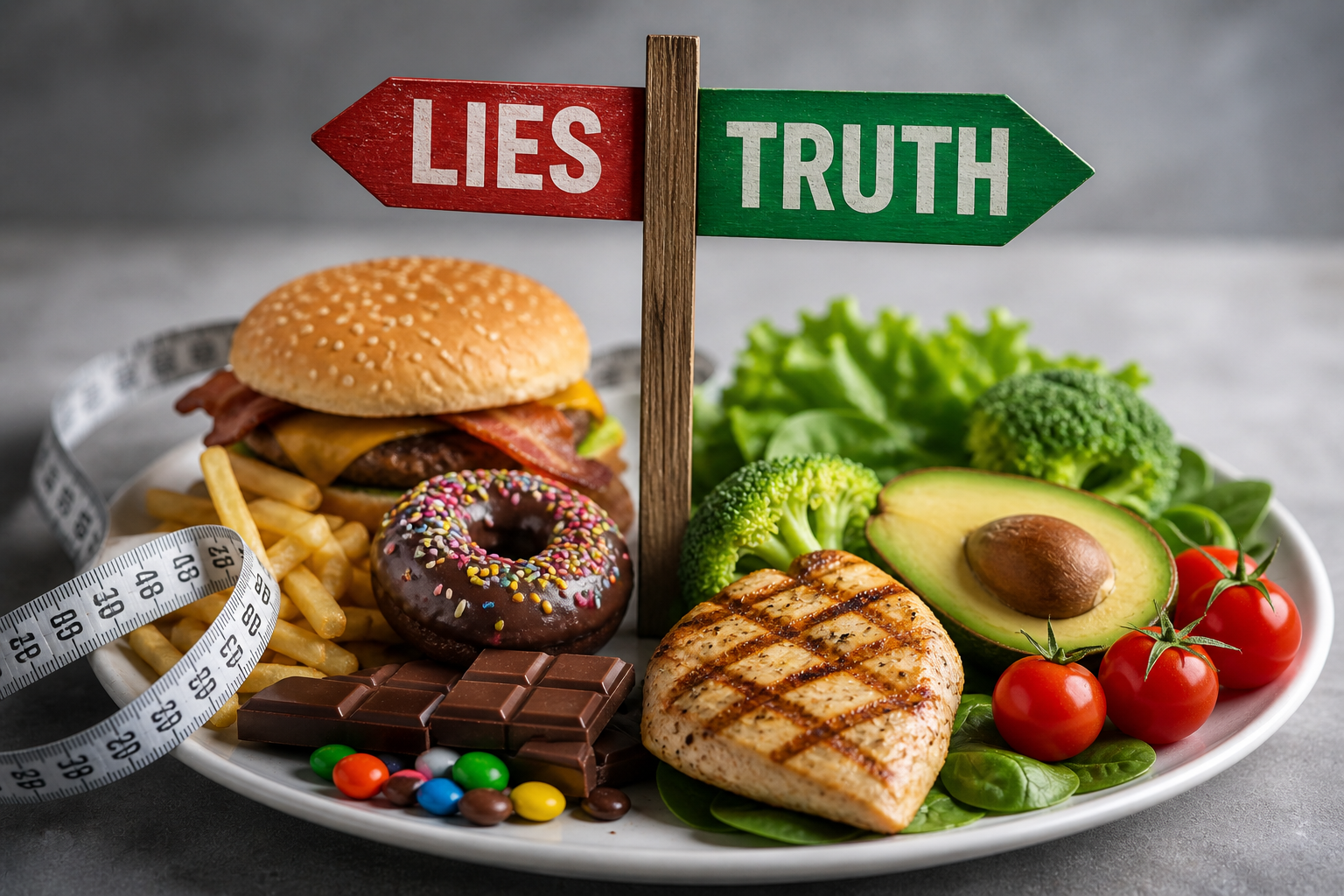
The 7 Biggest “Diet Lies” You’ve Been Told
If weight loss were really just about discipline, effort, or “wanting it badly enough,” we would not be seeing rising obesity rates, metabolic dysfunction, burnout, and frustration among people who are genuinely trying to improve their health. Yet millions of people still feel stuck, confused, and discouraged despite constantly trying new diets, workouts, and strategies.
The problem is not that people are lazy or unwilling to work hard. The problem is that many people have been taught oversimplified and biologically inaccurate ideas about how the human body actually works. Over time, these beliefs create cycles of restriction, stress, cravings, exhaustion, and repeated weight regain that leave people feeling defeated.
Let’s break down some of the biggest diet lies keeping people trapped.
This is one of the most oversimplified ideas in modern nutrition. While calories absolutely matter, the body does not function like a simple math equation. The human body is adaptive, protective, and constantly responding to hormonal and environmental signals.
Lie #1: Weight Loss Is Just Calories In vs. Calories Out
When calories are chronically restricted, the body begins adapting in ways most people never expect. Metabolic output slows, hunger hormones increase, energy levels decline, recovery worsens, and fat storage becomes more protective. The body does not necessarily interpret aggressive calorie cutting as progress. Often it interprets it as stress or potential survival threat.
This is one reason many diets work temporarily but fail long term. The body adapts to the restriction, making fat loss harder to sustain over time.
Lie #2: If It’s Not Working, You’re Just Not Consistent Enough
Many people struggling with fat loss are actually extremely disciplined. They track food, follow routines, exercise consistently, and work incredibly hard trying to stay on plan. The issue is often not a lack of consistency. The issue is being consistent with a strategy that is working against their biology.
When people are repeatedly told they simply need more discipline, they often internalize failure and blame themselves instead of questioning whether the approach itself is flawed. This creates frustration, shame, and burnout instead of long-term solutions.
Consistency matters, but consistency with the wrong strategy can still produce poor results.
Lie #3: You Just Need More Willpower
Willpower is not a sustainable metabolic strategy. Hunger, cravings, fatigue, low energy, and plateaus are not simply signs of weakness or lack of motivation. They are biological signals that the body is responding to stress, instability, poor recovery, or inadequate nourishment.
When the body senses nutrient deficiency, repeated restriction, blood sugar instability, chronic stress, or exhaustion, it naturally increases the drive to eat while simultaneously becoming more protective of stored energy. This is why many people feel like they are constantly battling cravings or trying to “fight” their hunger all day long.
Eventually biology pushes back. No amount of mental toughness can permanently override the body’s survival systems.
Lie #4: Fat Loss Requires Constant Restriction
Many people spend years believing that success requires eating less and less over time. The problem is that restriction is not the same thing as regulation. Repeated dieting teaches the body that energy availability is unreliable, which encourages the body to conserve energy and protect fat stores more aggressively.
Over time this can lead to slower metabolic function, stronger cravings, reduced energy, poorer recovery, and increased difficulty maintaining fat loss. This is one reason weight regain is so common after aggressive diets. In many cases the body adapted exactly the way it was biologically designed to.
Fat storage under chronic stress and repeated restriction is often a survival response, not a personal failure.
Lie #5: If You Stop Dieting, You’ll Gain Weight
This belief keeps many people trapped in fear around food and constant dieting cycles. The truth is more nuanced than most people realize. Stopping extreme dieting itself does not automatically cause weight gain. Problems usually occur when people stop dieting but never improve the underlying biological signals driving cravings, blood sugar instability, stress eating, poor recovery, and metabolic dysfunction.
When the body becomes properly nourished, hormonally stable, well recovered, and metabolically supported, fat loss often becomes easier because the body no longer feels constantly threatened. The goal is not endless restriction. The goal is improving regulation and stability.
Lie #6: More Exercise Is Always Better
Exercise is incredibly beneficial for health, insulin sensitivity, strength, body composition, and metabolism. However, more is not always better, especially when combined with chronic under-eating and poor recovery.
Excessive training can increase stress hormones, intensify cravings, disrupt recovery, increase fatigue, and make the body more protective of stored energy over time. Many people mistakenly believe they can simply “burn off” poor metabolic health through endless cardio and overtraining.
Exercise should support the body, not punish it. Strength training, intelligent programming, proper recovery, and consistent movement typically work far better long term than constantly trying to exhaust the body into fat loss.
Lie #7: Your Body Is Broken
This may be the most damaging belief of all. Many people eventually begin believing their body is permanently damaged because previous diets stopped working or because they can no longer lose weight the way they once did.
The truth is the body is rarely broken. It is adaptive and responsive. It constantly reacts to signals coming from stress, sleep, hormones, recovery, inflammation, food quality, activity levels, and nutritional consistency.
When the signals change, the outcome often changes as well. The body is always listening and responding to the environment it is being placed in.
The Truth Most People Aren’t Taught
Sustainable fat loss is not about starving yourself forever, constantly fighting hunger, training harder and harder, or relying on extreme discipline to survive. Real long-term progress comes from improving the internal environment the body operates in every single day.
Blood sugar regulation, proper nourishment, recovery, sleep quality, muscle support, stress management, inflammation control, and hormonal stability all play major roles in how the body responds metabolically. When the body feels biologically safe and supported, fat loss often becomes far more sustainable and realistic.
That is the difference between temporary dieting and lasting transformation.
Bottom Line
If you have tried everything and still struggle with your weight, that does not automatically mean you failed or that your body is broken. In many cases, it simply means you were taught the wrong rules about how metabolism and fat loss actually work.
Once you understand the biology behind the process, the entire conversation around fat loss starts to change.