
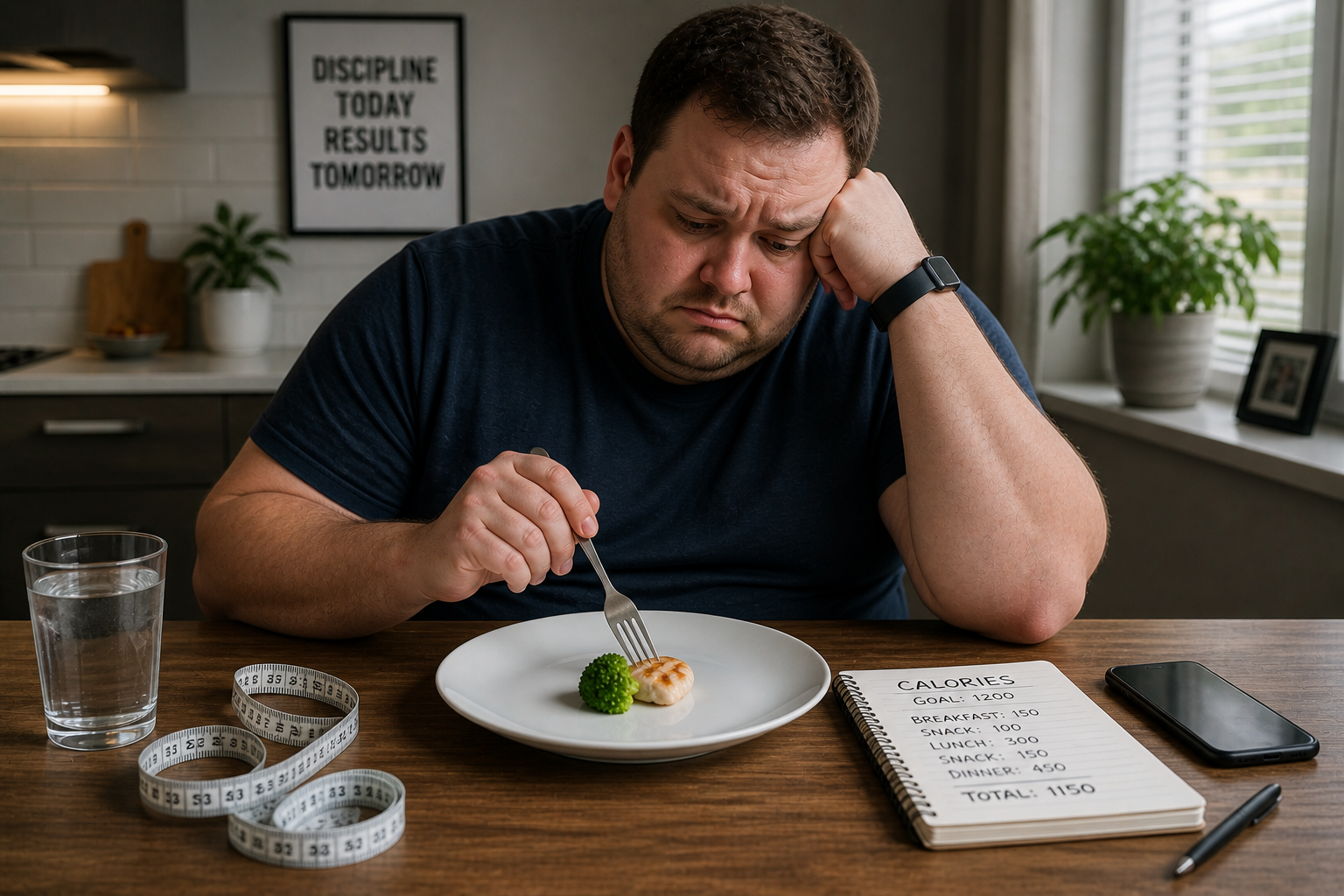
Why Cutting Calories Slows Your Metabolism and Keeps You Stuck
For decades, the diet industry has pushed the same message: eat less, move more, cut your portions, and force the weight off through restriction. Millions of people follow that advice every year believing that if they can just cut enough calories and stay disciplined long enough, their body will eventually cooperate.
At first, some weight usually comes off. The scale drops, motivation rises, and it feels like the diet is finally working. But after a few weeks, things begin changing. Hunger increases, energy drops, cravings intensify, workouts feel harder, recovery worsens, and fat loss begins slowing down or stops altogether. Eventually, many people regain the weight they lost and often gain back even more.
This is where most people start blaming themselves, when in reality the body is simply responding the way it was biologically designed to respond under stress.
Your Body Interprets Severe Calorie Restriction as a Threat
When calories drop too low for too long, the body does not view that as progress. It views it as a potential survival problem.
Your metabolism is designed primarily to keep you alive, not to help you fit into smaller clothes or hit an arbitrary number on the scale. When the brain senses prolonged food restriction, it begins activating protective mechanisms designed to conserve energy and improve survival.
Metabolism slows down. Thyroid output often decreases. Hunger hormones increase. Energy expenditure drops. Cravings become stronger. The body also becomes more efficient at storing energy because it is trying to protect itself from what it perceives as a period of scarcity.
This is why someone can begin a diet feeling motivated and in control, only to later feel exhausted, constantly hungry, emotionally drained, and obsessed with food. The body is not malfunctioning. It is responding exactly the way human physiology was designed to respond when energy availability becomes too low.
Why Muscle Loss Creates a Bigger Metabolic Problem
One of the biggest dangers of aggressive calorie cutting is the loss of lean muscle tissue.
When the body does not receive enough calories or enough protein, it often begins breaking down muscle for energy. This becomes a major metabolic problem because muscle tissue is one of the most metabolically active systems in the body. The more muscle someone loses, the fewer calories they naturally burn throughout the day.
As metabolism slows further, fat loss becomes increasingly difficult even though the person may still be eating very little. This creates the vicious cycle so many chronic dieters experience. They cut calories harder, metabolism slows more, hunger increases further, and eventually the entire system becomes unsustainable.
This is not a lack of discipline. It is metabolic adaptation.
Why Restrictive Dieting Increases Cravings and Overeating
The more aggressively someone restricts calories, the more aggressively the body often pushes back through hunger and cravings.
Leptin, one of the hormones involved in fullness and energy regulation, often decreases during aggressive dieting. Ghrelin, the body’s primary hunger hormone, tends to rise. At the same time, blood sugar instability and elevated stress hormones increase cravings for quick-energy foods, especially highly processed carbohydrates and sugar.
This is why many people eventually feel “out of control” around food after prolonged dieting. The body is trying to restore energy availability and protect itself from further deprivation.
Most people do not fail diets because they are weak. They fail because the biological environment created by chronic restriction eventually becomes impossible to sustain long term.
What Actually Supports Healthy Fat Loss
Sustainable fat loss requires a body that feels supported, nourished, and metabolically stable, not chronically deprived and stressed.
That starts with eating enough high-quality food to support muscle tissue, hormones, energy production, recovery, and blood sugar stability. Protein plays a major role because it helps preserve lean muscle while also improving fullness and satiety. Fiber-rich carbohydrates and healthy fats help slow digestion, stabilize energy, and reduce cravings throughout the day.
Strength training is equally important because muscle tissue acts like a metabolic engine. The more lean muscle someone maintains, the better their body becomes at regulating blood sugar, supporting metabolism, and burning calories efficiently both during activity and at rest.
Meal structure matters as well. Building meals around protein, fiber, and healthy fats creates a far more stable hormonal and metabolic environment than highly processed low-calorie foods ever will.
The goal should never be eating as little as possible. The goal should be creating an internal environment where the body can function efficiently while gradually improving body composition over time.
Why the “Eat Less” Mentality Keeps People Stuck
The diet industry continues promoting aggressive calorie cutting because it creates fast short-term scale changes that people mistake for long-term success.
But rapid weight loss achieved through chronic deprivation often comes with major tradeoffs including slowed metabolism, increased hunger, muscle loss, fatigue, hormonal disruption, poor recovery, and rebound weight gain.
People end up trapped in repeated cycles of restriction, frustration, regain, and starting over because the underlying metabolic dysfunction was never addressed in the first place.
A healthier metabolism is not built through starvation. It is built through proper nourishment, resistance training, stable blood sugar, recovery, and consistent biological support over time.
Bottom Line
Aggressively cutting calories does not create a healthier metabolism. In many cases, it creates a slower, more stressed, and more metabolically resistant body.
If you want long-term fat loss, the focus should not be on starving yourself into submission. The focus should be on supporting metabolism, preserving muscle, stabilizing hunger hormones, improving blood sugar control, and giving the body the nutrients it needs to function properly.
A nourished body functions more efficiently. Energy production improves, hunger becomes more stable, recovery improves, and the body is far more willing to support fat loss. A chronically deprived body responds very differently. Metabolism slows, cravings increase, energy drops, and the body shifts into a more protective state designed to conserve energy and improve survival.
That is not a character flaw or lack of discipline. It is normal human biology responding to prolonged nutritional stress.