
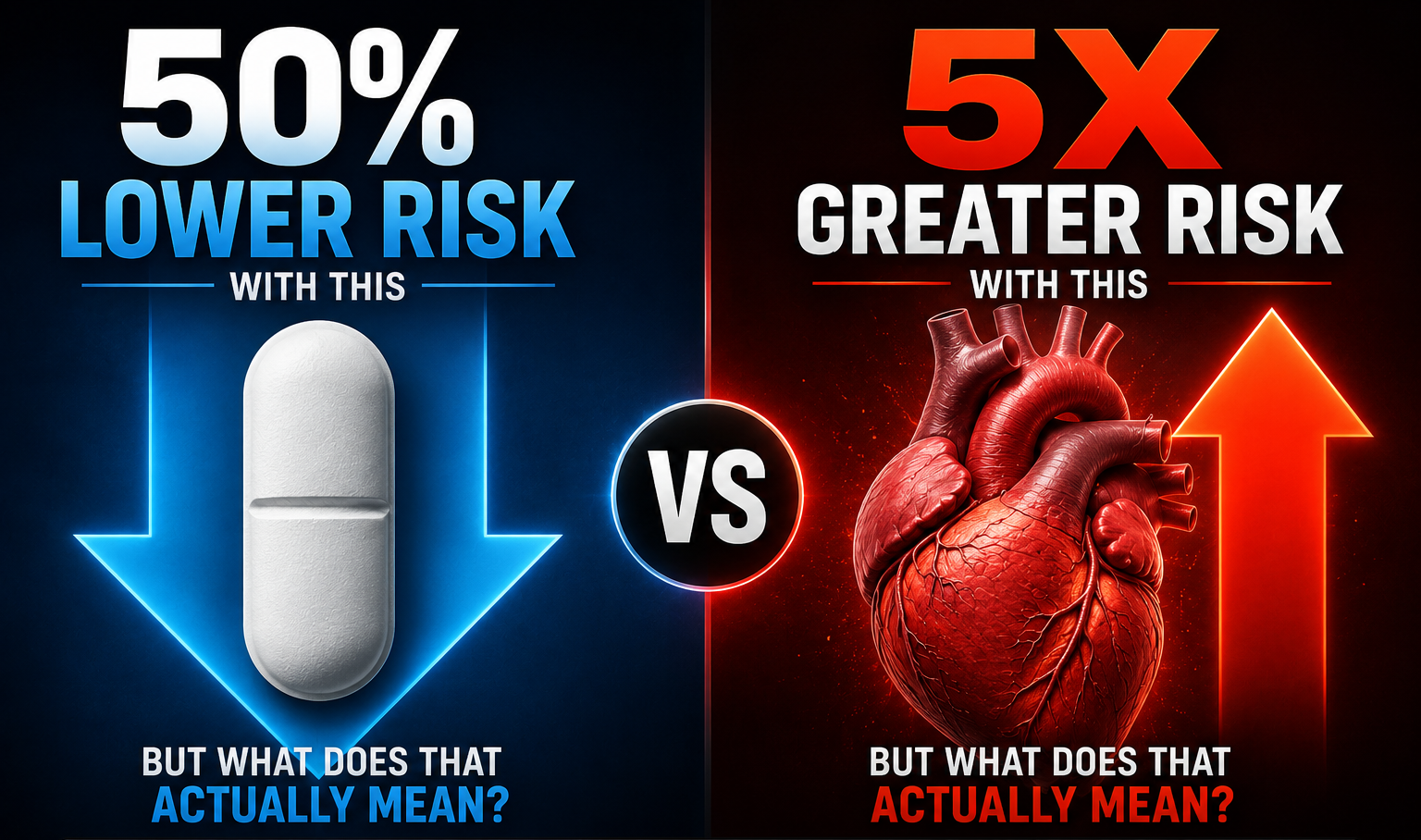
What Do “50% Lower Risk” and “5X Greater Risk” Really Mean?
Why Understanding Relative Risk and Absolute Risk Could Change the Way You View Your Health
Every day we’re exposed to health statistics. We hear them during prescription medication commercials, read them in newspaper headlines, see them discussed on television, and encounter them in conversations with healthcare providers. Statements such as, “This medication reduces your risk of a heart attack by 50%,” “People with this condition have a five times greater risk of having a stroke,” or “Without treatment, your risk doubles,” have become so common that most of us rarely stop to think about what those numbers actually mean.
They sound scientific. They sound authoritative. Because they’re presented with confidence, we naturally assume we understand them.
The reality is that many people have never been taught how to interpret these statistics correctly. That isn’t because they’re incapable of understanding them. It’s because most of us were never taught the basic principles of how medical research communicates risk. As a result, we often hear impressive percentages and dramatic comparisons without knowing what those numbers actually represent in terms of real people. That lack of understanding can leave us with a very different impression than the research itself intended.
This matters because health statistics influence some of the most important decisions we’ll ever make. They shape how we think about disease, how we evaluate treatment options, and how we perceive our own chances of developing future health problems. When we don’t fully understand the numbers, it’s easy to either overestimate or underestimate what they’re actually telling us. Neither response is helpful because good decisions are built on understanding, not assumptions.
The purpose of this article isn’t to tell you whether a medication is good or bad or whether you should or shouldn’t follow a particular treatment plan. Those decisions should always be made with your healthcare provider and based on your individual medical history, your personal risk factors, and your treatment goals.
My goal is much simpler.
I want to help you understand the language of health statistics so that the next time you hear phrases like “50% lower risk,” “five times greater risk,” or “your risk doubles,” you’ll have a much clearer understanding of what those numbers are actually saying.
One of the biggest reasons these statistics are misunderstood is that our brains naturally respond to percentages and large multipliers. If someone tells us our risk has doubled or increased fivefold, we instinctively focus on the size of the increase rather than the number it started from. That’s simply how human psychology works. We hear words like double, half, or five times greater, and our minds immediately picture a dramatic change. The problem is that percentages alone rarely tell the whole story.
Rather than talking about percentages, let’s make this as simple as possible.
Imagine we’re standing in a room with one hundred people. Everyone in the room is about the same age and has similar health characteristics. Using one hundred people instead of abstract percentages makes it much easier to picture what’s actually happening.
Now let’s start with one of the most common statements you’ll hear.
“People with this condition have a five times greater risk of having a stroke.”
At first glance, that sounds frightening. Most people hear the words five times greater and immediately picture a large percentage of the room suffering a stroke. However, that statement doesn’t tell us one very important piece of information.
Five times greater than what?
Let’s say that, in our room of one hundred people, one person would normally be expected to have a stroke during the next year.
Now let’s apply the statistic.
If a condition increases that risk fivefold, it doesn’t mean half the room is suddenly going to have a stroke. It simply means that instead of one person, approximately five out of one hundred people would now be expected to have one. The risk has increased from 1% to 5%. That’s certainly an important increase for the people affected, but it’s also very different from the picture many people imagine when they first hear the phrase “five times greater risk.”
Now let’s look at another statement you’ve probably heard countless times.
“This medication reduces your risk of a heart attack by 50%.”
Once again, let’s stay with our room of one hundred people.
Suppose that without taking the medication, two people out of those one hundred would be expected to have a heart attack during the next year. Now imagine that everyone in the room takes the medication. Instead of two people having a heart attack, only one person does. That’s where the “50% lower risk” comes from. The statement is mathematically correct, but many people picture a much larger change because “50% lower risk” sounds far more dramatic than two people becoming one person out of one hundred.
Let’s look at one final example.
You’ve probably heard someone say, “Without treatment, your risk doubles.”
Once again, imagine our room of one hundred people. If one person would normally be expected to experience a serious cardiovascular event during the next year, doubling that risk simply means two people would now be expected to experience one. Once again, the statistic is accurate.
The math hasn’t changed.
What changes is the picture people create in their minds when they hear the words “your risk doubles.”
Hopefully you’re beginning to notice a pattern. None of these examples suggest the statistics are wrong. They aren’t. Every one of them is accurate. What they illustrate is that percentages and multipliers don’t always tell the complete story. Without understanding the number you started with, it’s difficult to appreciate what those impressive percentages actually represent.
That brings us to one of the most important concepts in medical research, and once you understand it, you’ll never look at health statistics the same way again.
Understanding Relative Risk and Absolute Risk
The examples we just walked through all described the same information. The only difference was how that information was presented. In medical research, those two approaches are known as relative risk and absolute risk. Although the terminology may sound technical, the concepts are surprisingly simple. Once you understand the difference, you’ll see health statistics in a completely different way.
Relative risk compares one group of people to another. It tells us how much higher or lower the risk is compared with a different group. This is where statements such as “50% lower risk,” “your risk doubles,” and “five times greater risk” come from. Researchers use relative risk to compare treatments, identify risk factors, and measure how strongly a medication, behavior, or medical condition influences the likelihood of an event occurring.
Absolute risk answers a different question. Rather than describing how much the risk changed compared with another group, it tells us the actual likelihood of that event occurring. In other words, it translates percentages and multipliers into numbers that represent real people. For most people, this answers a much more personal question:
“What are my actual chances?”
Think back to our example involving a medication that reduced the risk of a heart attack by 50%. That statement represents the relative risk because it compares the outcomes of two different groups. When we looked at the same example using our room of one hundred people and saw that the expected number of heart attacks decreased from two people to one person, we were looking at the absolute risk. Both statements come from the same data, and both are completely accurate. They simply describe the results from two different perspectives.
This is why both statistics matter. Relative risk tells us how much the odds changed compared with another group, while absolute risk shows us what that change looks like in real people. Together, they provide a much more complete picture than either statistic alone.
Understanding this difference isn’t just an interesting lesson in statistics. It has practical value because the way health information is presented influences how we perceive risk, benefit, and urgency. Our brains naturally react to words like “double,” “half,” and “fivefold.” What we don’t naturally ask is what those percentages were calculated from. Yet that single piece of information often provides the context needed to understand the statistic.
For that reason, I believe one of the most valuable questions any patient can ask is:
“What does that mean in real numbers?”
Asking that question isn’t challenging the science or doubting your healthcare provider. It’s simply asking for the context needed to better understand what those numbers mean for someone in your situation. If someone tells you your risk has doubled, ask what it doubled from. If someone tells you a medication reduced your risk by 50%, ask what your original risk was before treatment and what it’s expected to be afterward. If someone tells you a particular condition increases your risk fivefold, ask how many people that actually represents.
Those questions don’t change the science. They simply help you understand it more completely. The better you understand the information you’re given, the better equipped you’ll be to ask thoughtful questions and make informed decisions that reflect both the scientific evidence and your own individual circumstances.
Understanding health statistics isn’t about becoming skeptical. It’s about becoming educated.
By this point, you may be thinking, “I understand the difference now, but why does any of this really matter?” It is an important question because understanding health statistics is only one part of becoming a more informed healthcare consumer. The other part is recognizing that while some health risks are beyond our control, many chronic metabolic conditions are also influenced by the choices we make every day. That’s where the conversation naturally shifts from understanding statistics to understanding the role that lifestyle plays in long-term health.
Why This Matters
At this point, you might be wondering why understanding the difference between relative risk and absolute risk is so important. After all, if both statistics are accurate, does it really matter which one is used?
I believe it does.
The way information is presented influences how we perceive it. That’s simply human nature. When we’re told our risk has doubled or that a medication cuts our risk in half, our attention is naturally drawn to those large percentages. What we often don’t stop to ask is how many people those percentages actually represent.
Imagine reading two newspaper headlines reporting on the exact same research study.
The first headline says, “New Medication Reduces Heart Attack Risk by 50%.”
The second says, “Expected Heart Attacks Decrease from Two People to One Person Out of Every One Hundred Treated.”
Both headlines are completely accurate because they’re describing the exact same study. However, most people would have a very different reaction to each one. The first headline sounds dramatic because it emphasizes the percentage. The second provides the actual numbers, giving us a much clearer understanding of the size of the change. Neither approach is wrong, but one provides far more context than the other.
This is why I believe patients deserve to understand both perspectives. Relative risk tells us how much the odds changed compared with another group, while absolute risk shows us what that change looks like in real people. Together, they provide a much more complete picture than either statistic alone.
Understanding these numbers also leads to better conversations with your healthcare provider. Rather than accepting a percentage at face value, you can ask questions such as, “What is my actual risk?”, “How much is this expected to change it?”, and “How do these numbers apply to someone with my age, medical history, and overall health?” Those answers provide context that percentages alone cannot.
It’s also important to remember that statistics describe groups of people, not individuals. Research tells us what happened across a population, but each of us has our own genetics, medical history, lifestyle, medications, and risk factors. That’s why two people with the same diagnosis may not have the same level of risk or receive the same treatment recommendations. Population statistics help guide medical decisions, but they should always be interpreted within the context of the individual.
One of the greatest benefits of understanding health statistics is becoming a more informed participant in your own healthcare. Instead of feeling overwhelmed by percentages or dramatic headlines, you begin asking better questions and gaining a deeper understanding of the information being presented. Knowledge doesn’t replace professional medical advice, but it helps you make more informed decisions alongside your healthcare provider.
The Other Half of the Conversation
Understanding health statistics is an important part of making informed healthcare decisions, but it’s only one piece of the puzzle. Equally important is recognizing that while some health risks are beyond our control, many of the chronic metabolic diseases affecting millions of people today are also influenced by the choices we make every day.
For conditions such as obesity, prediabetes, type 2 diabetes, metabolic syndrome, high blood pressure, and many forms of cardiovascular disease, decades of research have consistently shown that nutrition, physical activity, maintaining a healthy body weight, preserving lean muscle mass, getting adequate sleep, managing stress, and avoiding tobacco all play important roles in long-term health. These habits don’t eliminate every risk or replace appropriate medical care when it’s needed, but they do influence many of the biological processes that contribute to health and disease over time.
That’s one of the reasons I’ve dedicated so much of my career to helping people understand nutrition, exercise physiology, metabolism, and healthy aging. My goal has never been to tell people what to think. It’s been to help them understand how their bodies work so they can make more informed decisions for themselves.
When people understand both the science and its practical application, they’re less likely to rely solely on headlines, advertising claims, or social media opinions. Instead, they begin making decisions from a foundation of knowledge, and that’s where I believe every healthcare journey should begin.
Bottom Line
Health statistics play an important role in modern medicine, but they’re only useful if we understand what they actually mean. Hearing that your risk has doubled, increased fivefold, or been reduced by 50% tells only part of the story. Those numbers become far more meaningful when you also understand what they represent in terms of real people.
That’s why it’s important to understand both relative risk and absolute risk. Relative risk tells us how much the risk changed compared with another group, while absolute risk shows us what that change looks like in practical terms. Together, they provide a much clearer picture than either statistic alone.
The next time you hear a statement such as, “This medication reduces your risk by 50%,” or “Your risk doubles,” don’t be afraid to ask one simple question:
“What does that mean in real numbers?”
That question isn’t challenging the science or questioning your healthcare provider. It’s simply asking for the context needed to better understand the information being presented.
Perhaps the most important lesson isn’t about percentages at all. It’s about becoming an informed participant in your own healthcare. Good decisions are rarely made from headlines or isolated statistics alone. They’re made by understanding the complete picture, asking thoughtful questions, and working with qualified healthcare professionals to determine the approach that’s right for you.
That’s what science-based health education should do. It shouldn’t tell you what to think. It should give you the knowledge to better understand your health, ask better questions, and make more informed decisions with confidence. After all, understanding your health is one of the first steps toward improving it.
About the Author
Coach Tony is a Board-Certified Nutrition Specialist and Master Personal Trainer with over 40 years of experience in the health and fitness industry. He specializes in metabolic health, fat loss, and body composition, helping clients restore their metabolism through structured nutrition and resistance training.