
Why Counting Calories Isn’t Enough for Lasting Weight Loss
Many of us have been conditioned to believe that reaching a healthy weight requires counting calories, controlling portions, or staying within a strict number of points. For many, that number becomes the focus of every food decision. But a calorie count tells you how much energy a food provides, not the full story of how your body responds to it.
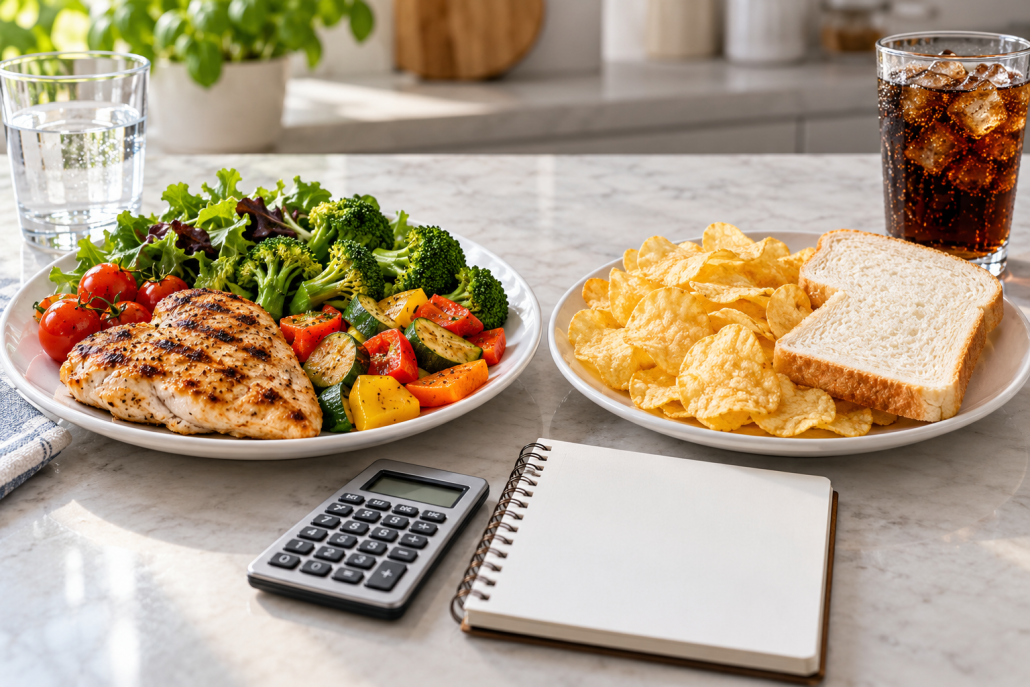
Consider two meals with the same calorie count. One is built around eggs, chicken, or fish with vegetables. The other is built around refined starch and a sweet drink. The numbers may match on paper, but those meals can affect your hunger, blood sugar, and the energy your body uses to process them differently.
Your body responds to food through biology, not a calorie calculator. Three responses help explain what that simple number leaves out.
1. The Thermic Effect of Food
Your body uses energy to digest, absorb, and process the food you eat. Protein has a thermic effect of approximately 20% to 30%, carbohydrates about 5% to 10%, and fat about 0% to 3%.
To see the difference, let’s start with 100 calories from each and use 25% for protein, 8% for carbohydrates, and 2% for fat:
Protein: Processing uses approximately 25 calories, leaving 75 after that processing cost.
Carbohydrates: Processing uses approximately 8 calories, leaving 92 after that cost.
Fat: Processing uses approximately 2 calories, leaving 98 after that cost.
These are simplified estimates of the energy cost of processing each macronutrient. All three started at 100 calories, but your body used different amounts of energy along the way. A calorie count or point value doesn’t show you that difference.
2. The Glycemic Response
The glycemic response describes how your blood sugar changes after you eat. Refined starches and sugary drinks can raise blood sugar rapidly. Protein, fiber, and the other foods eaten with a carbohydrate can change the size and speed of that rise.
Imagine choosing a sweet drink because it fits your calorie allowance. The number tells you nothing about what happens to your blood sugar after you drink it. If you’re working to improve your metabolic health, that missing information matters.
Satiating value is how well a food satisfies hunger. Compare a meal of chicken and vegetables with chips and a soda. Even at the same calorie count, the protein and fiber in the first meal can help you feel satisfied longer. The second can be much easier to consume without feeling equally full.
3. The Satiating Value
That difference affects real life. If your meal leaves you hungry again soon afterward, staying within a calorie or point allowance becomes harder, regardless of how carefully you planned it.
This is why counting calories can make perfect sense on paper and still fall short in practice. The number does not tell you what it took to process the meal, how your blood sugar responded, or whether you’ll be satisfied until the next one. Those responses influence the food decisions you make throughout the day.
For lasting weight loss, the question shouldn’t be “How many calories is this?” It should be “What will these calories do inside my body?”
About the Author
Coach Tony is a Board-Certified Nutrition Specialist and Master Personal Trainer with over 40 years of experience in the health and fitness industry. He specializes in metabolic health, fat loss, and body composition, helping clients restore their metabolism through structured nutrition and resistance training.