
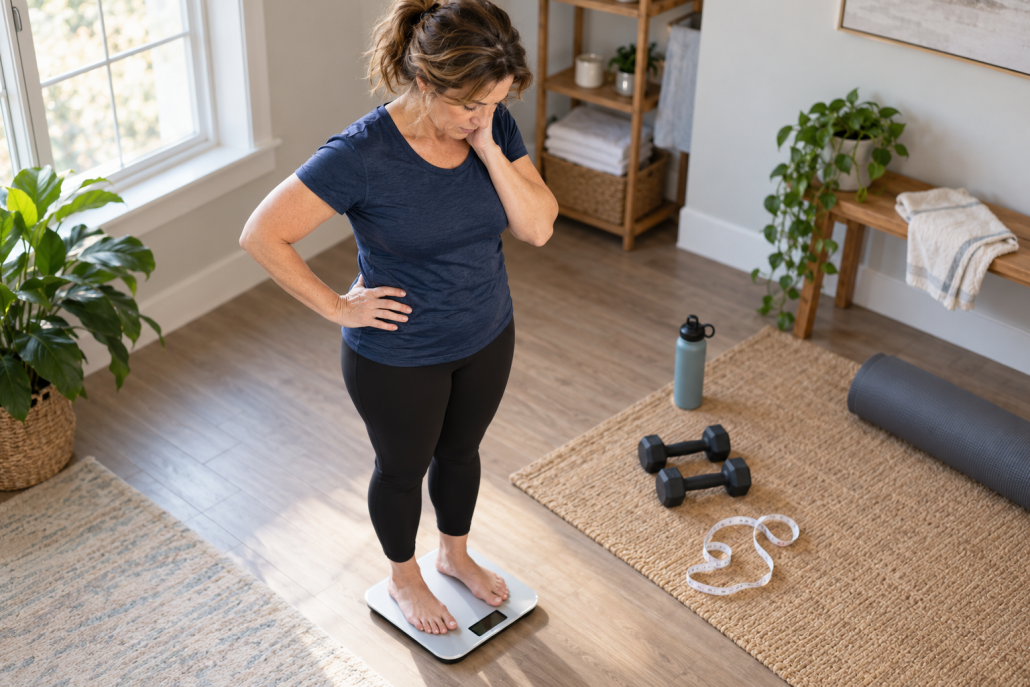
When Did the Number on the Scale Become So Important?
My wife and I were having a conversation last night about something that I think we have gotten terribly wrong when it comes to health, weight loss and how people have been taught to look at their own bodies. Why have we convinced society that the number staring back at us from a bathroom scale is so incredibly important?
Think about how early this starts. We go to the doctor and we’re weighed, we’re given a BMI and told where we fall on a chart, then the commercial diet industry reinforces it by celebrating pounds lost, weight loss companies build entire marketing campaigns around it, and MLM marketers show us before and after pictures accompanied by some dramatic number on the scale.
After hearing this long enough, people naturally begin to believe that losing weight means they’re getting healthier and gaining weight means they’re moving in the wrong direction.
What Does the Scale Actually Tell Us?
But what does that number actually tell us about the composition of the human body? Not nearly as much as we’ve been conditioned to believe. If you lose 20 pounds, I want to know what you lost. Did you lose primarily body fat, or did a meaningful amount of lean tissue disappear with it? How much was water and glycogen? Did your waist circumference change? Did you preserve your muscle and strength?
Those are very different outcomes, yet the bathroom scale can make all of them look exactly the same because all it knows is that you weigh 20 pounds less.
BMI has many of the same limitations when we try to use it to define an individual. It takes your height and weight and turns those two measurements into another number, but it doesn’t directly tell us how much muscle you’re carrying, how much body fat you’re carrying or where that fat is located.
Two people can be the same height, weigh exactly the same amount and therefore have the exact same BMI, while having dramatically different body compositions. The problem isn’t that weight and BMI can never provide useful information. The problem is how much importance we have taught people to place on them when judging individual health and progress.
Can an Online Quiz Measure Your Metabolic Health?
And now we’re watching this same mentality move online, only this time it’s being packaged as something that sounds far more scientific. You may have seen advertisements offering to “check your metabolic health” through a quick questionnaire about your weight, energy, cravings, sleep or lifestyle.
Unless that specific test and scoring system has been clinically validated to measure what it claims, the resulting score should not be treated as a measurement of metabolic health. A questionnaire can collect useful information, but it doesn’t directly measure your blood glucose, A1C, blood pressure or body composition.
Looking at the Bigger Picture
If you really want to understand your metabolic health, let’s look at things we can actually measure. Body composition, waist circumference, fasting glucose, A1C, fasting insulin when appropriate, triglycerides, HDL cholesterol and blood pressure can all contribute meaningful information, while strength and physical fitness tell us something about the function of the body itself.
No single one of these measurements defines metabolic health, but when we put the pieces together and follow how they’re trending over time, we begin to see something a bathroom scale, BMI calculation or online quiz simply cannot show us.
This is where I believe we’ve conditioned people to chase the wrong outcome. We’ve taught people to pursue weight loss, when what many should really be pursuing is an improvement in body composition and metabolic health. Becoming lighter and becoming healthier are not necessarily the same thing, particularly if significant lean tissue is being lost in the process.
I would much rather see someone improve the composition and metabolic function of their body while becoming stronger and more physically capable than simply celebrate a lower number on the scale.
A Better Way to Judge Progress
After more than four decades of working with people, I’ve watched far too many allow that number to determine whether they feel successful or defeated. The scale drops and they’re happy, it rises and suddenly they believe everything they’re doing must be wrong, even though hydration, glycogen, sodium, food volume and other normal physiological changes can move body weight without representing a meaningful change in body fat.
We’ve given that little number sitting on the bathroom floor an incredible amount of power, while rarely stopping to ask how much it actually tells us about the body standing on top of it.
Maybe it’s time we stopped allowing one number to define something as complex as the human body. The scale can provide information, BMI can provide information, but neither tells the entire story, and neither should determine whether you believe you’re succeeding or failing.
Maybe the question was never simply, “How much do you weigh?” Maybe the better question has always been, “What is that weight made of, and what is happening metabolically underneath it?”
About the Author
Coach Tony is a Board-Certified Nutrition Specialist and Master Personal Trainer with over 40 years of experience in the health and fitness industry. He specializes in metabolic health, fat loss, and body composition, helping clients restore their metabolism through structured nutrition and resistance training.