
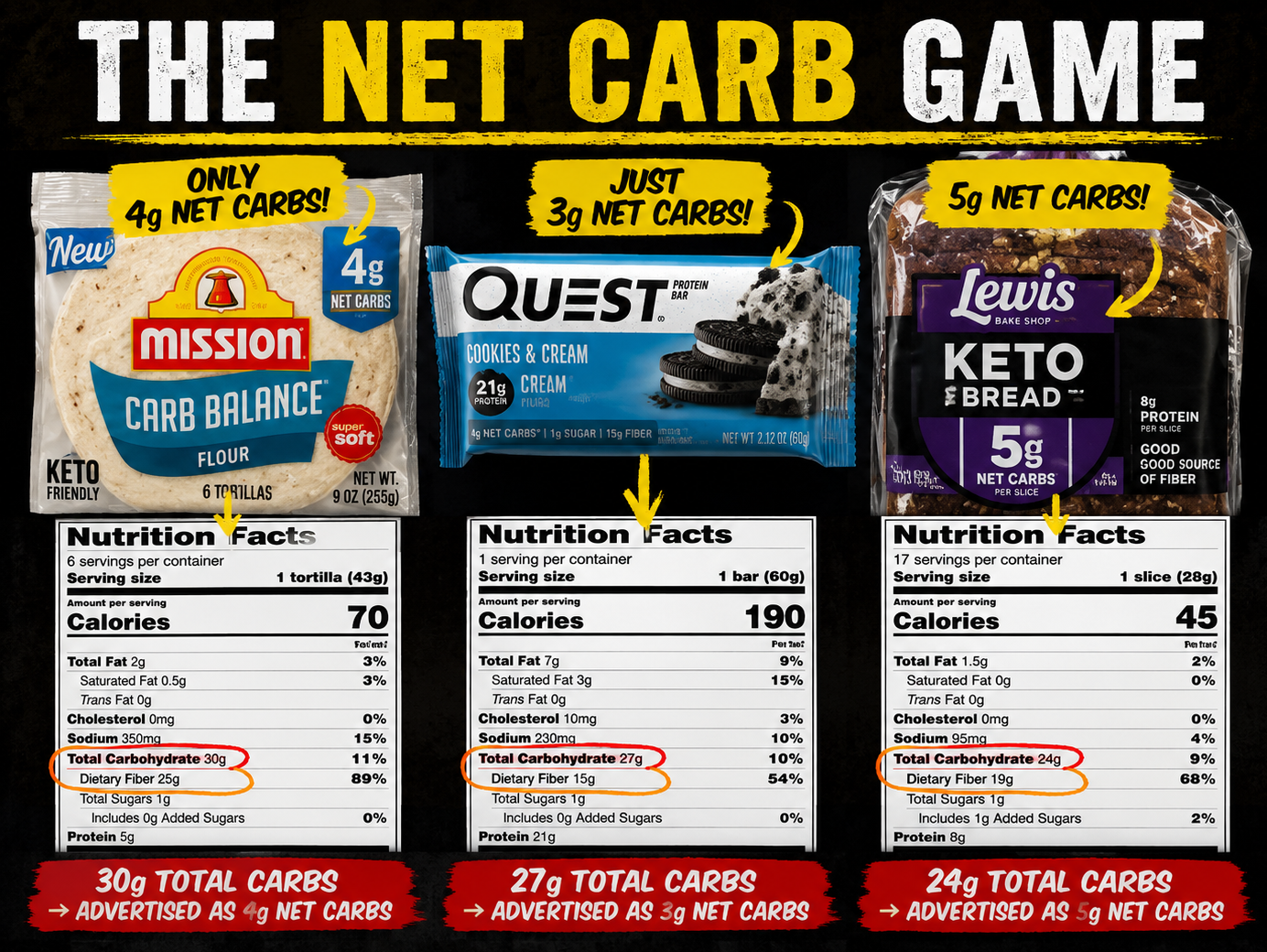
The Net Carb Game: What Consumers Need to Know
Why subtracting fiber from total carbohydrates may not tell the whole story.
If you’ve spent any time looking at food labels over the past several years, you’ve probably noticed the growing popularity of “net carbs.”
Keto breads, low-carb tortillas, protein bars, protein cereals, low-carb wraps, snack foods, and countless other products now prominently display net carb claims on the front of their packaging. For consumers trying to lose weight, improve blood sugar control, or follow a lower-carbohydrate lifestyle, these claims can appear extremely appealing.
The concept sounds simple enough. Take the total carbohydrate content of a food, subtract the fiber, and what remains is presented as the number of carbohydrates that supposedly matter.
For many consumers, that calculation has become accepted as fact. Unfortunately, the reality is often much more complicated.
Understanding The Net Carb Calculation
The math typically looks something like this:
Total Carbohydrates = 30 grams
Fiber = 20 grams
Net Carbs = 10 grams
In other words, the manufacturer wants you to believe that a 30-gram carbohydrate product is really only a 10-gram carbohydrate product because the fiber has been subtracted from the equation.
The message is simple: don’t worry about those other 20 grams because they supposedly don’t count.
At first glance, that may sound reasonable. The problem is that many consumers stop their analysis right there and never look beyond the net carb number displayed on the front of the package.
Why Consumers Get Into Trouble
This is where many people unknowingly work against their own goals.
Someone picks up a low-carb tortilla, protein bar, or keto bread and notices that it contains only 5 or 10 net carbs. Suddenly the product feels like a free pass. They eat more of it, buy it more often, and convince themselves they’re making a better nutritional choice because the net carb number appears low.
If you’re struggling with insulin resistance, prediabetes, diabetes, excess body fat, or weight loss, that’s exactly the kind of thinking that can work against your goals.
The reality is that your body doesn’t see a marketing claim. Your body responds to the food you actually eat, the ingredients contained in that food, the amount of processing involved, your activity level, your overall calorie intake, and your individual metabolic health.
Food Manufacturers Understand Consumer Psychology
Food manufacturers understand how attractive a low net carb number is to consumers.
As a result, many companies formulate products specifically to increase fiber content and reduce the net carb number displayed on the front of the package. This strategy is especially common in keto breads, low-carb wraps, tortillas, protein bars, protein cereals, and other highly processed convenience foods.
A product may contain 25, 30, or even 40 grams of total carbohydrates, yet consumers are encouraged to focus primarily on the much smaller net carb number highlighted on the front of the package.
From a marketing perspective, it’s incredibly effective.
From a consumer education perspective, it can sometimes be misleading.
The Fiber Misunderstanding
Before going any further, it’s important to clarify something.
Fiber is not the enemy.
Fiber plays an important role in digestive health, satiety, gut health, and overall wellness. In fact, most people would likely benefit from consuming more fiber, not less.
The problem occurs when consumers begin viewing fiber as a magic eraser that automatically makes the rest of the carbohydrates in a product irrelevant.
Not all fibers behave the same way in the body. Different fibers have different physiological effects, and newer research continues to demonstrate that the relationship between fiber, digestion, energy utilization, and metabolism is far more complex than simply subtracting one number from another.
Fiber should be viewed as part of the nutritional picture, not as a free pass that automatically eliminates the significance of the carbohydrates contained in a food.
What Should Consumers Focus On Instead?
When evaluating a food product, I encourage clients to look beyond the net carb claim and examine the entire nutritional profile.
Start by looking at the total carbohydrate content.
Then review the ingredient list.
Consider the degree of processing involved.
Evaluate the overall quality of the food and ask yourself whether it genuinely supports your health goals.
A food does not automatically become healthy because the net carb number is low, just as a food does not automatically become unhealthy because the total carbohydrate number is higher.
Nutrition is rarely that simple.
The Bottom Line
The net carb game has become one of the most effective marketing strategies in modern nutrition because it allows consumers to believe they are eating fewer carbohydrates without necessarily eating better food.
When you’re evaluating a product, don’t let the net carb number make the decision for you. Read the ingredient list, look at the total carbohydrate content, and then ask yourself whether that product truly supports your health goals.
About the Author
Coach Tony is a Board-Certified Nutrition Specialist and Master Personal Trainer with more than 45 years of experience in the health and fitness industry. He specializes in metabolic health, fat loss, body composition, and healthy aging, helping clients restore their metabolism through structured nutrition and resistance training. Through Get Your Lean On, Coach Tony provides science-based nutrition education designed to help people make informed decisions and achieve lasting results.