
7 Food-Labeling Tricks Every Consumer Should Understand
Why many of the healthiest-looking foods in the grocery store may not be as healthy as they appear.
If you’ve ever stood in a grocery store aisle trying to determine whether a food is actually healthy, you’re not alone.
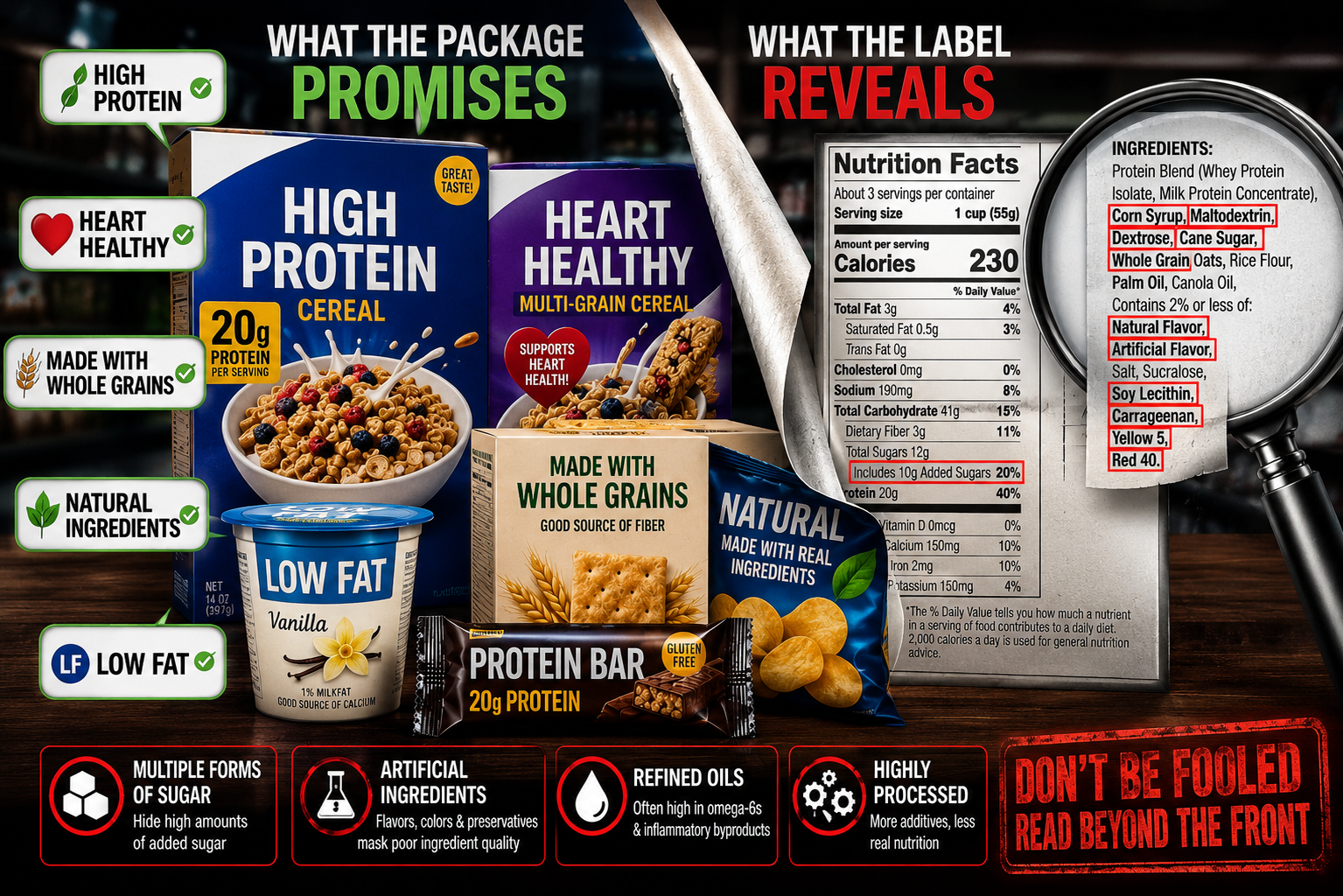
Modern food packaging has become a masterclass in marketing. Nearly every aisle is filled with products boasting claims such as “High Protein,” “Heart Healthy,” “Made with Whole Grains,” “Low Fat,” “Reduced Sugar,” “Gluten Free,” “Excellent Source of Fiber,” and “Fortified with Vitamins and Minerals.”
At first glance, these claims sound reassuring. In fact, they’re designed to. The challenge for consumers is determining whether these statements actually reflect the overall nutritional quality of the food or simply highlight one positive attribute while drawing attention away from everything else.
The reality is that many of these claims are technically accurate, legally permitted, and fully compliant with government labeling regulations. The problem is that consumers often assume these statements tell the entire story when, in reality, they frequently represent only a small piece of a much larger nutritional picture.
Food manufacturers understand something very important about human behavior. Most shoppers do not spend fifteen minutes standing in a grocery aisle analyzing ingredient lists and nutrition facts panels. Research consistently shows that purchasing decisions are often made within seconds. Manufacturers know this, which is why the front of a package is carefully designed to influence your decision long before you ever turn the product over and examine what is actually inside.
In many ways, the front of the package serves as an advertisement while the back serves as a disclosure. Unfortunately, most consumers spend far more time looking at the advertisement than they do reading the disclosure.
Over the years, I have found that most food-label manipulation falls into seven common categories. Learn to recognize them, and you’ll never look at food packaging the same way again.
1. Serving Size Manipulation
One of the oldest tricks in food marketing involves serving sizes. Manufacturers know that nutrition information is reported per serving, not necessarily per package. By defining serving sizes in ways that do not reflect how people actually eat, products can appear lower in calories, sugar, sodium, or fat than they truly are in the real world.
A cookie that appears to contain only 90 calories may actually contain 360 calories once you realize the package contains four servings. A bottle of juice that looks reasonable at first glance may contain two or three servings despite being sold as a single beverage. Muffins, snack foods, beverages, and countless other products routinely use serving sizes that bear little resemblance to how consumers actually consume them.
Historically, one of the most controversial examples involved trans fats. Food-labeling regulations allowed manufacturers to report 0 grams of trans fat if the product contained less than 0.5 grams per serving. Consumers naturally assumed this meant the product contained no trans-fat at all. In reality, consuming multiple servings throughout the day could result in meaningful trans-fat intake despite every label claiming “0 grams.”
Similar rounding rules apply to other nutrients as well. Small amounts of sugar, fat, and other ingredients can sometimes be rounded down on food labels depending on serving size and regulatory thresholds. While these rules are legal, they can create the impression that a product contains none of a particular ingredient when, in fact, small amounts are present.
This may not sound like a significant issue, but consider a product that contains 0.49 grams of trans fat per serving. A consumer who eats multiple servings throughout the day could unknowingly consume several grams of trans fat while believing they consumed none at all. The same principle applies to products marketed as containing zero sugar, zero fat, or zero calories when those values have simply been rounded down according to labeling regulations.
One of the most important lessons consumers can learn is that “legally rounded down to zero” does not always mean zero. Whenever possible, evaluate the entire product, examine the ingredient list, and consider how much you are actually likely to consume rather than relying solely on the numbers displayed on the front of the package.
2. Ingredient Splitting
Food manufacturers understand that consumers often pay attention to the order in which ingredients appear on a label. Since ingredients are listed by weight, many shoppers become suspicious when sugar appears near the top of the ingredient list. As a result, manufacturers have developed strategies to make products appear healthier without necessarily changing the overall nutritional composition of the food.
One of the most common tactics is ingredient splitting. Rather than using a single source of sugar, manufacturers frequently divide it into multiple forms such as cane sugar, corn syrup, dextrose, maltodextrin, rice syrup, fruit juice concentrate, honey, and sucrose. While each individual sweetener may appear lower on the ingredient list, collectively they can represent one of the largest components of the product. The ingredient panel may look healthier at first glance, but the overall nutritional impact of the food often remains largely unchanged.
3. Health Halo Marketing
Perhaps the most powerful marketing strategy used in the food industry today is what researchers refer to as the health halo effect. A health halo occurs when a single positive characteristic causes consumers to perceive an entire product as healthy.
Food manufacturers routinely capitalize on this phenomenon by highlighting claims such as “High Protein,” “Low Fat,” “Whole Grain,” “Natural,” “Plant-Based,” “Gluten Free,” and “Made with Real Fruit.” While these claims may be technically accurate, they often represent only one small aspect of the product.
The problem is that consumers frequently allow one positive attribute to influence their perception of the entire food. A protein cereal may still be highly processed. A low-fat product may compensate for reduced fat by adding significant amounts of sugar. A whole-grain snack may still be calorie-dense and contain numerous refined ingredients.
The claim itself may be true, but the impression it creates is often where the confusion begins.
4. The Protein Effect
Perhaps no modern food trend illustrates the health halo effect better than the explosion of protein-enhanced foods.
Consumers have become increasingly aware of the importance of protein for muscle maintenance, satiety, healthy aging, weight management, and metabolic health. Food manufacturers have responded by introducing protein cereals, protein chips, protein cookies, protein brownies, protein bars, protein desserts, and countless other products designed to capitalize on this demand.
Protein itself is not the problem. Protein is an essential nutrient that plays a critical role in human health.
The problem occurs when consumers assume that adding protein automatically transforms a processed food into a healthy food.
In some cases, the protein-enhanced version may actually contain more ingredients, more sweeteners, more additives, more stabilizers, and more processing than the original version it was designed to improve. Consumers focus on the added protein while overlooking the broader nutritional profile of the product.
A high-protein claim should never be viewed as a shortcut for determining whether a food is healthy. The question is not simply how much protein a product contains. The better question is what kind of food it actually is.
5. Ingredient Padding
Ingredient padding occurs when manufacturers add small amounts of desirable nutrients simply so they can advertise them on the package. Omega-3 fatty acids, fiber, protein, probiotics, collagen, antioxidants, vitamins, and minerals are commonly used for this purpose.
The amount added may be nutritionally insignificant, yet the marketing value can be enormous. Consumers see the ingredient and immediately associate the product with health and wellness.
Unfortunately, adding a small amount of a beneficial nutrient does not erase the effects of excessive sugar, refined starches, highly processed oils, artificial ingredients, or poor overall food quality. A highly processed cereal with added vitamins is still a highly processed cereal. A junk food with added protein remains junk food if the overall nutritional profile has not meaningfully improved.
6. Front-of-Package Distraction Marketing
Food companies spend enormous amounts of money studying consumer psychology. They know which colors attract attention, which images create trust, and which words influence purchasing decisions.
That is why food packages often feature beautiful fruit, green fields, healthy athletes, fresh grains, nuts, vegetables, and active families. Words such as natural, wholesome, clean, simple, and healthy are strategically placed to reinforce those visual cues.
The package is designed to create a perception. Whether the ingredients support that perception is an entirely different question.
Consumers should never assume that the images on a package accurately represent the nutritional quality of what is inside.
7. Legal Does Not Mean Healthy
Perhaps the most important lesson of all is understanding that a legal claim is not necessarily a meaningful claim.
A cereal can be an excellent source of vitamins and still contain significant amounts of added sugar. A snack can be high in protein and still be highly processed. A product can contain whole grains and still be a poor nutritional choice. A food can be low fat and still be loaded with sugar.
The claim itself may be accurate. The impression it creates may be misleading.
This is where food marketing and consumer misunderstanding often collide. The front of the package highlights a positive attribute while the broader nutritional reality remains hidden in plain sight.
The Bottom Line
The healthiest foods in the grocery store rarely require a marketing department to convince you they are healthy.
Real foods such as eggs, poultry, fish, vegetables, fruits, and minimally processed meats speak for themselves because their nutritional value does not depend on clever packaging or carefully crafted marketing claims.
The next time you pick up a package, don’t stop reading after the words on the front. Turn it over. Read the ingredient list. Read the nutrition facts panel. Evaluate the overall quality of the food rather than focusing on a single marketing claim.
Because the front of the box was designed to sell you the product.
The back of the box was designed to tell you what is actually in it.
Learn the difference, and you’ll make better nutrition decisions than most consumers ever will.
About the Author
Coach Tony is a Board-Certified Nutrition Specialist and Master Personal Trainer with over 40 years of experience in the health and fitness industry. He specializes in metabolic health, fat loss, and body composition, helping clients restore their metabolism through structured nutrition and resistance training.