
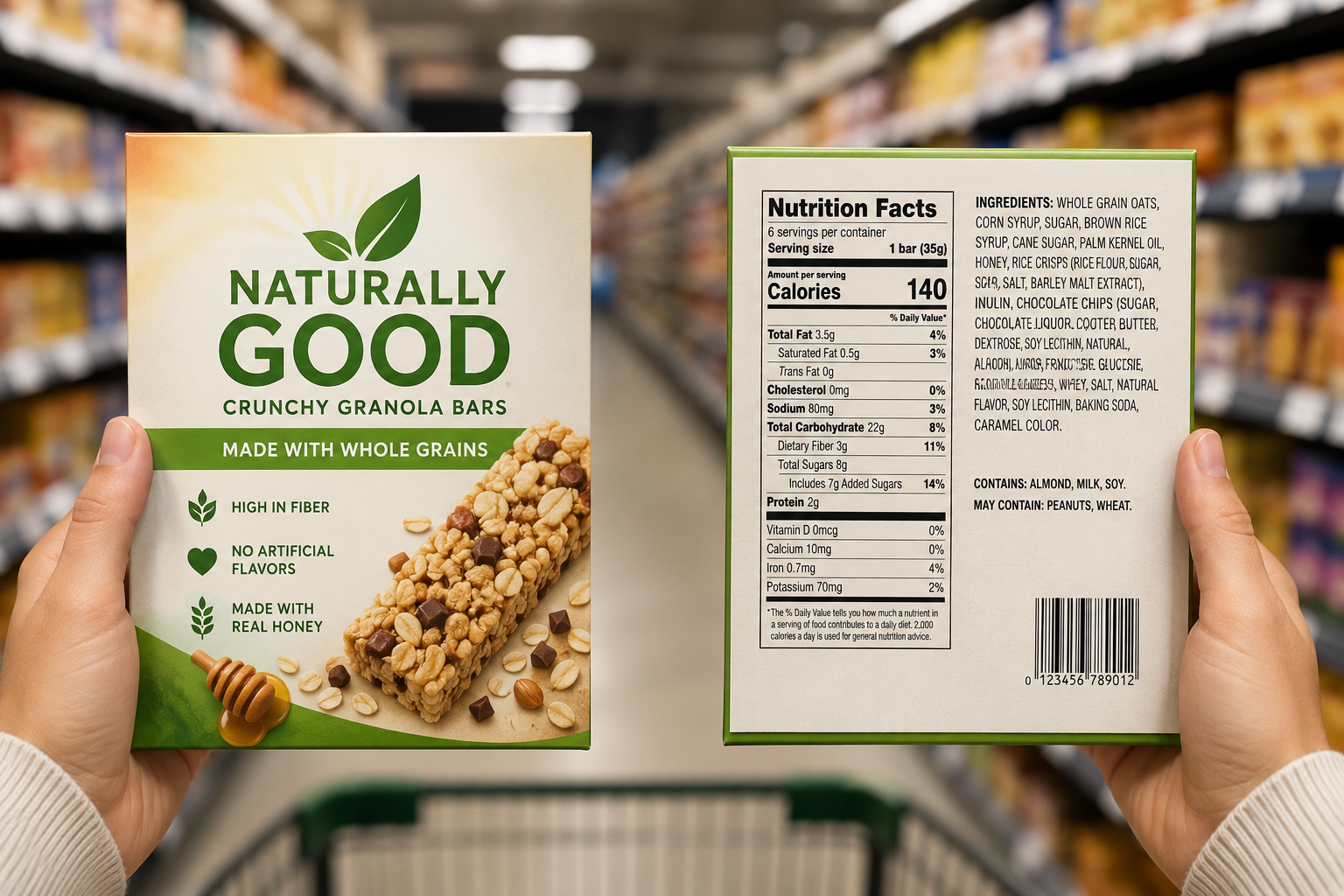
Health Halo Marketing: How Food Companies Make Processed Foods Look Healthier Than They Really Are
Why the front of the package often tells a very different story than the Nutrition Facts Panel
Walk through any grocery store today and you’ll quickly discover that modern food packaging has become remarkably sophisticated. Food manufacturers spend millions of dollars every year researching consumer behavior, testing marketing messages, designing labels, and studying the psychology behind purchasing decisions. Their goal is not simply to inform consumers about the products they sell. Their goal is to influence buying behavior.
Most consumers make purchasing decisions within seconds. Because of this, food companies understand that the front of a package may be the only opportunity they have to capture a shopper’s attention. As a result, food packaging has evolved into a carefully designed marketing tool that often emphasizes a few positive characteristics while drawing attention away from other aspects of the product that may deserve equal consideration.
This strategy is commonly known as health halo marketing.
A health halo occurs when one positive attribute creates the impression that an entire product is healthy. The claim itself may be accurate, but the perception it creates often extends far beyond what the claim actually means. Consumers see a favorable statement on the package and unconsciously assume the entire product supports their health goals without taking the time to evaluate the bigger nutritional picture.
Understanding how health halo marketing works can dramatically improve your ability to make informed decisions every time you walk through the grocery store.
The Front Of The Package Is Advertising
One of the most important concepts consumers can understand is that the front of a package is advertising while the Nutrition Facts panel is information.
Food manufacturers know exactly which words attract attention and influence purchasing decisions. Terms such as high protein, low fat, fat free, low calorie, heart healthy, made with whole grains, natural, gluten free, and made with Greek yogurt are strategically placed on the front of packages because they create positive associations in the minds of consumers.
The challenge is that these claims often represent only a small portion of the product’s overall nutritional profile. A food may contain one desirable characteristic while simultaneously containing large amounts of added sugar, highly refined ingredients, excessive calories, or a lengthy list of additives and preservatives.
Consumers who focus exclusively on the front of the package often miss the information that matters most. The Nutrition Facts panel and ingredient list provide a much more complete picture of what is actually being purchased.
Why Serving Sizes Fool So Many Consumers
One of the most common areas of confusion on food labels involves serving sizes.
Nutrition information is reported per serving, not necessarily per package. While this complies with labeling regulations, it often creates a disconnect between what consumers believe they are eating and what they are actually consuming.
For example, a frozen dessert may advertise 100 calories, 7 grams of protein, and 12 grams of sugar. At first glance, those numbers may appear reasonable. However, if the container contains three servings and an individual consumes the entire package, they are actually consuming 300 calories, 21 grams of protein, and 36 grams of sugar.
This is not uncommon. Many products marketed as healthier alternatives rely heavily on serving-size assumptions that do not accurately reflect how consumers eat in the real world. Beverages, frozen desserts, snack foods, cereals, and packaged treats frequently appear healthier when evaluated by serving rather than by container.
One of the most important habits consumers can develop is calculating what they are actually consuming rather than relying solely on the numbers highlighted on the front of the package.
The Protein Marketing Boom
Few nutrition trends have been more aggressively marketed in recent years than protein.
Consumers have become increasingly aware of protein’s role in muscle maintenance, healthy aging, recovery, appetite control, and metabolic health. In response, food manufacturers have introduced protein cereals, protein chips, protein cookies, protein pancakes, protein waffles, protein desserts, protein ice creams, and countless other products designed to capitalize on consumer demand.
Protein itself is not the issue. Protein is an essential nutrient that plays a critical role in overall health.
The problem arises when consumers begin using protein content as a shortcut for determining whether a food is healthy. Adding protein to a highly processed product does not automatically transform it into a nutritious food. In many cases, protein-enhanced foods contain additional ingredients, sweeteners, stabilizers, gums, flavorings, and processing methods that consumers rarely consider because their attention has been directed toward the protein claim.
The question should never be whether a food contains protein. The question should be whether the overall product supports your nutritional goals.
How Ingredient Lists Can Be Manipulated
Most consumers know that ingredients are listed by weight, with the ingredients present in the largest amounts appearing first.
Food manufacturers understand this as well.
One strategy commonly used throughout the food industry is known as ingredient splitting. Rather than using one large source of sugar, manufacturers may divide sugar into multiple forms such as cane sugar, dextrose, maltodextrin, corn syrup, rice syrup, honey, fruit juice concentrate, and sucrose.
Because each sweetener is listed separately, none may appear particularly high on the ingredient list. However, when combined, they may represent one of the largest components of the product.
To the average consumer, the ingredient panel may appear more balanced than it truly is. The nutritional impact, however, remains largely unchanged.
This is why evaluating the ingredient list requires looking beyond individual ingredients and understanding the product as a whole.
Why Words Like “Natural” Often Mislead Consumers
Few words create more confusion than the term natural.
Many consumers automatically associate natural with healthy, nutritious, minimally processed, or beneficial. Unfortunately, the reality is often far more complicated.
A product can contain significant amounts of sugar, highly refined ingredients, processed oils, and various additives while still using language that creates the impression of wholesomeness. Similarly, packages frequently feature images of fresh fruit, green fields, healthy families, vegetables, grains, and active lifestyles because these visual cues reinforce the desired perception of the product.
The goal of packaging is to create a positive emotional response. Whether the product itself supports that perception is a separate question entirely.
Consumers should never assume that a picture, slogan, or marketing phrase accurately reflects the nutritional quality of what is inside the package.
What Smart Consumers Look For
The most informed consumers understand that no single claim determines whether a food is healthy.
A product can be high in protein and still be highly processed. A food can be low fat and still contain significant amounts of sugar. A cereal can be fortified with vitamins and minerals while providing very little overall nutritional value. A snack can contain whole grains while still being little more than a highly processed convenience food.
Instead of focusing on one claim, consumers should evaluate several factors before making a purchasing decision.
Ask yourself:
• How many servings are in the package?
• How much sugar am I consuming if I eat the entire package?
• What are the first five ingredients?
• How heavily processed is the product?
• Does the overall nutritional profile align with my goals?
• Am I evaluating the food or simply responding to the marketing?
These questions often reveal far more about a product than any claim printed on the front of the package.
The Bottom Line
Food companies are exceptionally skilled at marketing. Their success depends on their ability to influence consumer behavior, and many of the claims found on food packaging are specifically designed to create positive perceptions about a product.
The solution is not fear, restriction, or obsessing over every label. The solution is education.
The more you understand how health halo marketing works, the easier it becomes to separate advertising from nutritional reality. The next time you pick up a package that proudly advertises high protein, low fat, natural, heart healthy, or low calorie, take a moment to turn it over and examine the information that most consumers overlook.
The truth about a food is rarely found on the front of the package. More often than not, it is found in the details printed on the back.
About the Author
Coach Tony is a Board-Certified Nutrition Specialist and Master Personal Trainer with over 40 years of experience in the health and fitness industry. He specializes in metabolic health, fat loss, and body composition, helping clients restore their metabolism through structured nutrition and resistance training.