
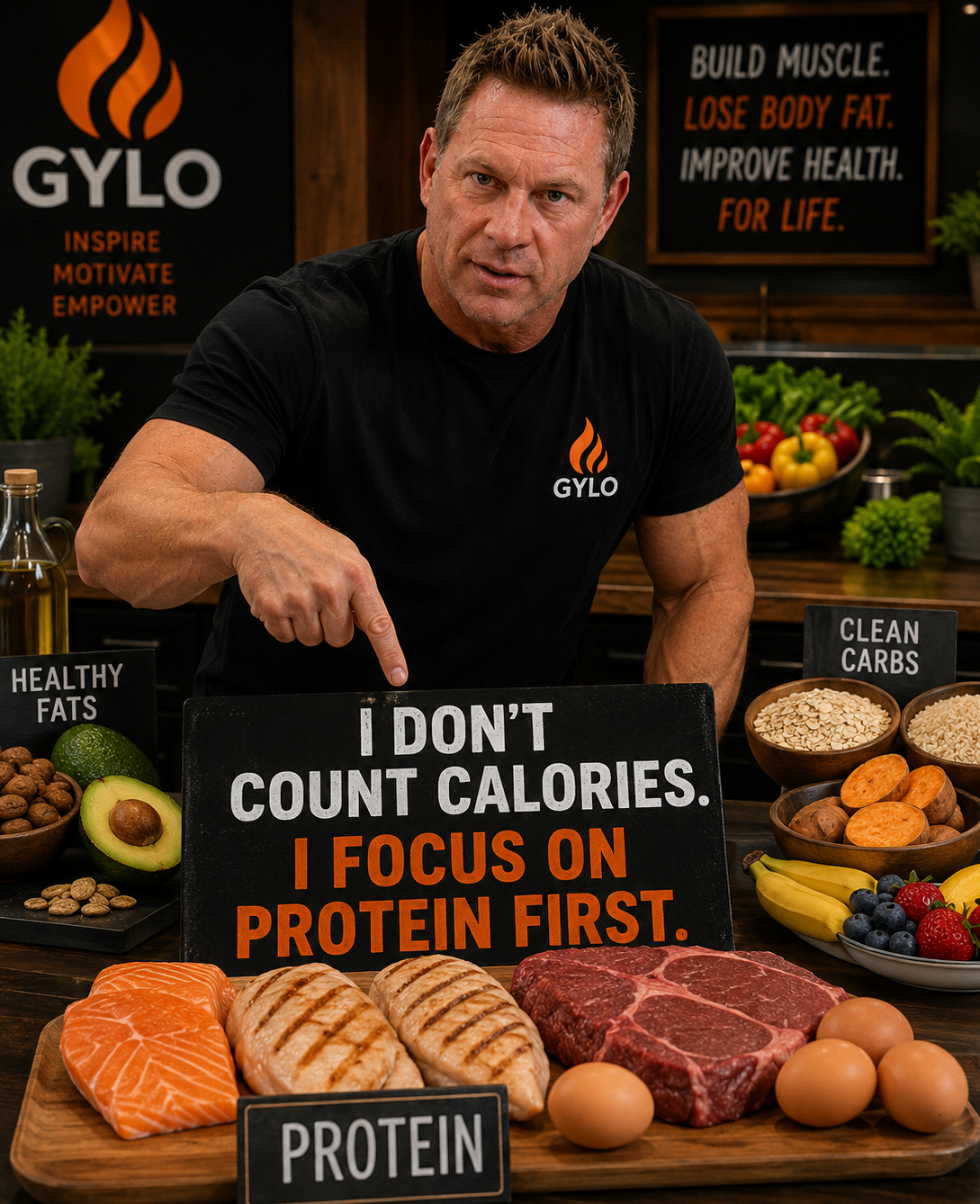
Why I Stopped Counting Calories Over 30 Years Ago
Why Prioritizing Protein and Macronutrients May Be One of the Smartest Nutrition Decisions You Can Make
The other day at the gym, I had an interesting conversation with someone after we finished talking about resistance training, building muscle, losing body fat, and improving body composition. Before we wrapped up, they asked me a question that caught me a little off guard.
“Coach, how many calories do you eat every day?”
I smiled and answered honestly.
“I have no idea.”
The look on their face immediately told me that wasn’t the answer they were expecting. They quickly followed it up with another question.
“Then how do you stay so lean and maintain your muscle?”
It’s a fair question, and one I’ve been asked many times throughout my career. After all, we’ve spent decades being taught that successful nutrition begins by counting calories. Nutrition apps encourage us to log everything we eat. Restaurant menus prominently display calorie counts. Diet books often revolve around staying within a daily calorie budget, and countless fitness influencers tell us that weight loss is simply a matter of eating fewer calories than we burn. It’s no wonder so many people believe calories are the foundation of good nutrition.
While calories certainly have an important place in nutrition, over the past 45 years I’ve come to believe they’re often where people begin asking the wrong question.
The truth is, I haven’t counted calories since my competitive bodybuilding days back in the early 1990s.
That answer surprises many people, especially considering I’ve spent my career studying nutrition, metabolism, exercise physiology, resistance training, and body composition. Most assume that someone in my profession carefully tracks every calorie they consume, weighs every portion, and knows exactly how many calories they eat each day.
I don’t.
As my education continued and my coaching experience grew, my philosophy about nutrition gradually began to change. The more scientific research I read and the more people I coached, the more convinced I became that long-term success wasn’t about becoming better at counting calories. It was about becoming better at nourishing the body.
Today, every meal I eat begins with protein.
Once my protein needs are covered, I add carbohydrates and healthy fats according to my activity level, training demands, body composition goals, and overall health. It isn’t a complicated system, but after decades of coaching thousands of people, I’ve found it to be far more practical and sustainable than constantly trying to hit an arbitrary calorie target.
One of the biggest mistakes I see people make is becoming so focused on calories that they completely overlook what they’re actually eating. They celebrate because they stayed under a certain calorie goal, yet they’re not consuming enough protein to support muscle maintenance, recovery, satiety, physical performance, or healthy aging. They’re paying close attention to the quantity of energy they’re eating while overlooking the quality of the nutrition they’re providing their body.
In my opinion, that’s putting the cart before the horse.
After more than four decades of coaching, I’ve found that people generally experience far greater long-term success when they stop obsessing over calorie totals and begin paying closer attention to protein intake, food quality, and the overall balance of the macronutrients they’re consuming. Nutrition becomes less stressful, meals become easier to plan, hunger is often easier to manage, and the habits they develop become much more realistic to maintain for years instead of weeks.
That doesn’t mean calories suddenly stop mattering.
Calories represent energy, and energy balance certainly plays a role in body weight. The laws of physics haven’t changed, nor am I suggesting they have. However, understanding that calories matter is very different from believing that counting every calorie should become the foundation of your nutrition plan. Those are two very different ideas, and understanding that distinction completely changed the way I coach people today.
Why My Thinking About Nutrition Changed
Like many people entering the fitness industry several decades ago, I believed calorie counting was one of the most important aspects of good nutrition. During my competitive bodybuilding years, tracking calories simply came with the territory. Every meal was measured, every serving was calculated, and every calorie was recorded. At the time, I genuinely believed that was exactly what I needed to do to achieve my goals.
As the years passed, however, I began noticing something that didn’t quite make sense.
Many people became exceptionally good at counting calories, yet they continued struggling to lose body fat, preserve muscle, control their hunger, maintain their results, or keep the weight off after reaching their goal. They had become experts at tracking numbers, but many still felt frustrated every time they sat down to eat.
At the same time, I watched other people take a very different approach. Rather than allowing calories to dictate every food choice they made, they focused on building balanced meals around adequate protein, quality carbohydrates, healthy fats, and whole, minimally processed foods. They weren’t perfect, and they certainly weren’t counting every calorie, but they were remarkably consistent. They maintained healthier body compositions, had better energy, recovered more effectively from exercise, and developed eating habits they could actually sustain over the long term.
Watching those two groups over many years changed the way I thought about nutrition.
Instead of asking how many calories someone was eating, I began asking a different question.
Was their body receiving the nutrients it needed to function at its best?
That simple shift completely changed my coaching philosophy.
Understanding What Calories Really Measure
Calories are one of the most recognized terms in nutrition, yet they’re also one of the most misunderstood.
A calorie is simply a unit of energy. It tells us how much potential energy a food contains, but it tells us remarkably little about the nutritional value of that food. Calories don’t tell us how much protein a meal provides. They don’t tell us whether that meal contains adequate fiber, vitamins, minerals, or healthy fats. They don’t tell us how satisfying the meal will be, how it may influence blood sugar, or whether it provides the nutrients necessary to support muscle maintenance, recovery, immune function, or overall health.
Consider two meals that each contain approximately 500 calories.
One meal consists of grilled chicken, roasted vegetables, and a baked potato.
The other consists of a large pastry and a sugary coffee drink.
From a calorie standpoint, they’re remarkably similar.
From a nutritional standpoint, they’re completely different.
The chicken dinner supplies high-quality protein, complex carbohydrates, fiber, vitamins, minerals, and nutrients that support muscle maintenance, recovery, and long-term health. The pastry and coffee provide roughly the same amount of energy but significantly less protein, fewer essential nutrients, and far less nutritional value.
Calories tell us how much energy is in a meal however, they do not tell us how nutritious that meal actually is.
Calories Are Estimates, Not Exact Measurements
Another fact that surprises many people is that calorie values should be viewed as estimates rather than exact measurements.
Food manufacturers determine calorie values using standardized laboratory testing and accepted scientific formulas, but natural variation exists in every food we eat. Differences in growing conditions, processing methods, cooking techniques, portion sizes, fiber content, and even the way our own digestive systems function all influence how much usable energy our bodies ultimately obtain from a meal. The Nutrition Facts label provides valuable information, but it cannot predict with perfect precision exactly how many calories every individual will absorb.
Human metabolism is remarkably complex, and no two people process food exactly the same way. That’s one of the reasons I gradually stopped making calories the centerpiece of my nutrition philosophy. The more I learned about nutrition and human physiology, the more I realized that biology is far more complex than simple arithmetic.
Why Protein Became the Foundation of My Nutrition Plan
As my education continued and my coaching experience grew, one principle became impossible to ignore.
Protein deserves far more attention than it typically receives.
Over the past several decades, nutrition researchers have consistently demonstrated that adequate protein intake plays a critical role in preserving lean muscle mass, supporting recovery from exercise, regulating appetite, maintaining physical function, supporting immune health, and promoting healthy aging. Unlike carbohydrates and fats, protein supplies the amino acids your body requires to build, repair, and maintain virtually every tissue in the body. While all three macronutrients are essential, protein occupies a unique position because there is simply no substitute for the work it performs.
This becomes especially important during weight loss.
One of the biggest mistakes I see people make is dramatically reducing the amount of food they eat without giving enough thought to protein intake. As body weight decreases, they often lose both body fat and lean muscle tissue. While the number on the scale may look encouraging, losing muscle is never the goal. Muscle supports strength, mobility, balance, metabolic health, insulin sensitivity, and independence as we age. Preserving it should always be one of the highest priorities of any nutrition program, whether your goal is weight loss, better health, or simply aging well.
Protein also happens to be the most satiating of the three macronutrients. Numerous studies have shown that meals containing adequate amounts of protein generally help people feel fuller for longer periods after eating. That often leads to better appetite control and may naturally reduce overall food intake without someone constantly thinking about calories. Rather than relying on willpower alone, the body begins working with you instead of against you.
Another advantage of protein is something known as the thermic effect of food. Simply put, your body uses more energy to digest, absorb, and metabolize protein than it does carbohydrates or fat. While this isn’t dramatic enough to drive weight loss by itself, it illustrates an important principle that often gets overlooked. Your body responds differently to different nutrients. Two diets containing the same number of calories may not produce identical results because the body processes protein, carbohydrates, and fats differently.
This is one of the reasons I’ve gradually shifted my focus away from calorie counting and toward balancing macronutrients. Calories tell us how much energy a food contains. Macronutrients tell us what that food is actually providing the body.
Why Macronutrients Matter
The word “macronutrient” simply refers to the three nutrients our bodies require in the largest amounts: protein, carbohydrates, and fat. Each serves a unique purpose, and each contributes to good health in its own way.
Protein provides the building blocks necessary to build and preserve muscle, repair tissues, manufacture enzymes and hormones, and support countless biological processes throughout the body.
Carbohydrates serve as the body’s preferred source of energy for many daily activities and exercise. Whole-food carbohydrate sources such as fruits, vegetables, legumes, and whole grains also provide fiber, vitamins, minerals, and numerous beneficial plant compounds that support overall health.
Healthy fats are equally important. They help produce hormones, support brain function, protect organs, aid in the absorption of fat-soluble vitamins, and contribute to healthy cell membranes throughout the body.
The goal should never be eliminating one macronutrient in favor of another. Instead, the goal should be consuming an appropriate balance of all three while ensuring that adequate protein serves as the nutritional foundation. When people begin looking at food through that lens, something interesting often happens. Their food choices naturally improve because they begin selecting foods based on the nutrients they provide rather than simply the calories they contain. Calories haven’t disappeared from the equation, but they no longer dominate every food decision.
A Simpler and More Sustainable Way to Eat
One of the reasons I moved away from calorie counting more than 30 years ago was because I watched it create unnecessary stress for so many people. Meals became math problems instead of opportunities to nourish the body. Eating out with family or friends often created anxiety, and social gatherings became exercises in guilt rather than occasions to simply enjoy good food and good company. Instead of learning how to build balanced, nutritious meals, many people became consumed with tracking numbers that were estimates to begin with.
I believe nutrition should do exactly the opposite.
It should simplify your life, not complicate it.
That doesn’t mean portion sizes no longer matter or that calories should be completely ignored. It simply means your primary focus should shift from chasing numbers to consistently building meals that nourish your body. When you prioritize protein, include quality carbohydrates and healthy fats, eat mostly whole, minimally processed foods, and stay physically active, many of the things people hope to achieve by obsessively counting calories often begin happening naturally.
That’s certainly been my experience, both personally and professionally.
After coaching people for more than 45 years, I’ve learned that consistency almost always beats perfection. The clients who achieve the best long-term results aren’t necessarily the ones who own the most sophisticated nutrition app or log every bite of food for the rest of their lives. They’re the people who establish simple habits they can realistically maintain year after year because those habits become their lifestyle.
Bottom Line
Calories certainly matter because they represent the energy contained within food, and maintaining an appropriate energy balance plays an important role in body weight. However, after more than four decades of studying nutrition and coaching thousands of individuals, I’ve come to believe that calories should not be the primary focus of a healthy nutrition plan.
Food is far more than energy. Food supplies the protein that preserves our muscles, the carbohydrates that fuel our activity, the healthy fats that support hormone production and brain function, the vitamins and minerals that allow our bodies to function properly, and the countless other nutrients that contribute to long-term health. When we reduce nutrition to nothing more than a calorie total, we risk overlooking everything else food has to offer.
That doesn’t mean calorie counting never has a place. There are situations where tracking calories can provide useful information, particularly for athletes, bodybuilders, or individuals working toward very specific body composition goals. I’ve done it myself, and during certain phases of my competitive bodybuilding career it served a purpose. But for most people simply trying to lose weight, improve their health, preserve muscle, and develop eating habits they can sustain for the rest of their lives, I believe there’s a better place to begin.
Your nutrition doesn’t have to be complicated. In my experience, long-term success usually comes from consistently following a few fundamental principles:
- Start with protein.
- Build balanced meals around quality carbohydrates and healthy fats.
- Choose mostly whole, nutrient-dense foods.
- Strength train regularly.
- Stay physically active.
- Be consistent.
Those habits have guided my own nutrition for more than 30 years, and they’ve become the foundation of the philosophy I continue to teach today. I no longer worry about how many calories I eat each day because my focus has shifted toward something I believe is far more important—providing my body with the nutrients it needs to perform at its best, preserve muscle, support good health, and continue doing the things I enjoy for many years to come.
About the Author
Coach Tony is a Board-Certified Nutrition Specialist and Master Personal Trainer with over 40 years of experience in the health and fitness industry. He specializes in metabolic health, fat loss, and body composition, helping clients restore their metabolism through structured nutrition and resistance training.